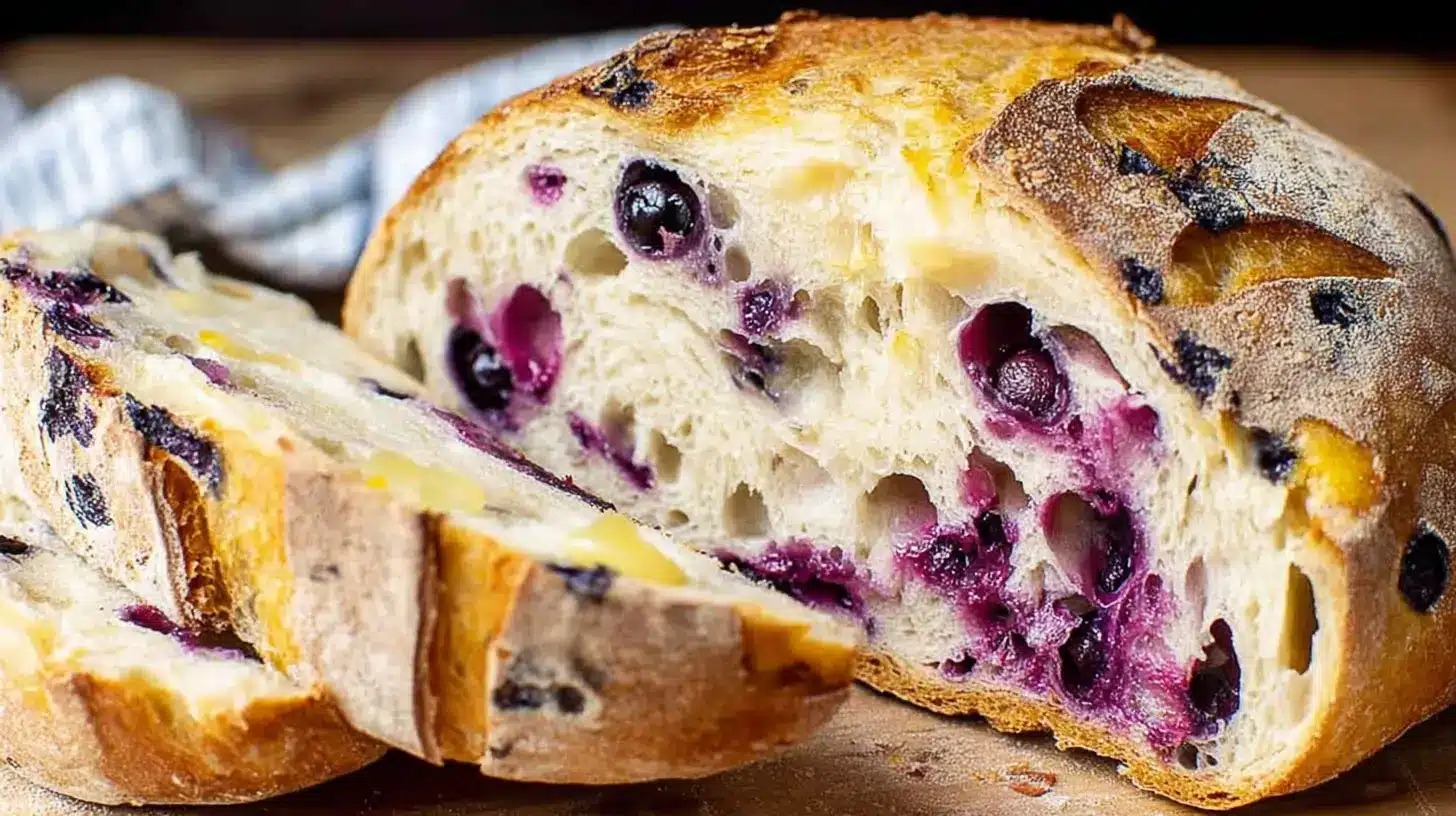
Lemon Blueberry Sourdough Bread pairs a classic artisan loaf with sunny citrus and jammy berries. You’ll build a lively dough, strengthen it with gentle folds, laminate in lemon zest and blueberries so they’re beautifully distributed, then cold-proof overnight for deep flavor. The next day, the boule bakes inside a blazing-hot Dutch oven for dramatic oven spring and a glossy, golden crust. Slice into it and you’ll see a tender, custardy crumb ribboned with purple-blue pockets and perfumed with lemon—equally perfect for breakfast toast, afternoon tea, or a giftable centerpiece loaf.
Why You’ll Love This Lemon Blueberry Sourdough Bread
- Bright, natural flavor: Fresh lemon zest perfumes the dough while blueberries burst into jammy pockets.
- Stunning look: A golden ear on top and speckled cross-section make this loaf irresistibly photogenic.
- Great texture: A thin, crisp crust yields to a soft, moist crumb thanks to proper gluten development and steam.
- Make-ahead friendly: The long, cold proof builds flavor while you sleep and fits any schedule.
- Versatile serving: Toast with a swipe of creamy spread, pair with fruit, or turn leftovers into French toast.
- Reliable method: Clear cues (“watch the dough”) help you adapt to your flour, climate, and starter.
What Is Lemon Blueberry Sourdough Bread?
Lemon Blueberry Sourdough Bread is an artisan-style loaf naturally leavened with active sourdough starter, then layered with fresh lemon zest and blueberries. Instead of kneading add-ins at the start (which can smash berries and tear gluten), you’ll laminate them late in bulk fermentation: stretch the dough into a thin sheet, scatter zest and berries, and fold it like a letter. This keeps the gluten strong and the fruit mostly intact. A long, cool proof allows the dough to ferment slowly and evenly. Baked in a ripping-hot Dutch oven, the loaf traps steam for maximum rise and a blistered, shiny crust. The result is a balanced bread—tart-sweet and aromatic—that feels special without being fussy.
Lemon Blueberry Sourdough Bread
Lemon Blueberry Sourdough Bread combines a classic crusty artisan loaf with vibrant lemon zest and juicy blueberry pockets. Baked in a Dutch oven after an overnight cold proof, it delivers a tender, airy crumb, golden crust, and a bright aroma that makes every slice irresistible—perfect for breakfast toast, tea time, or a standout brunch centerpiece.
Levain/Starter & Base Dough
- 160 g active sourdough starter (100% hydration) (bubbly and doubling reliably)
- 400 g strong white bread flour (≥12–13% protein)
- 240 g room-temperature water (hold back 10–20 g if needed)
- 1 tsp fine sea salt
- 1 tbsp granulated sugar (optional for tenderness and browning)
Mix-Ins
- 2 lemons, zested (avoid white pith)
- 150 g fresh blueberries (small and firm)
Dusting
- 2 tbsp rice flour or all-purpose flour (for dusting banneton and handling)
Step 1 – Build starter: Feed your sourdough starter 6–12 hours before mixing until bubbly and doubled.
Step 2 – Autolyse: Mix flour and 220–230 g water until shaggy. Cover and rest 30–60 minutes.
Step 3 – Mix dough: Add starter, salt, and sugar. Mix using stretch-and-fold or slap-and-fold method until smooth and elastic. Add remaining water if needed.
Step 4 – Bulk fermentation: Ferment at warm room temp (75–78°F/24–26°C) for 3–5 hours. Do 3–4 coil folds in the first 2 hours, spaced 30–40 minutes apart.
Step 5 – Laminate: Stretch dough on a damp surface into a thin rectangle. Scatter zest and blueberries, then fold like a letter. Return to container seam side down. Rest 20–30 minutes. Optionally, do one gentle coil fold if dough is slack.
Step 6 – Finish bulk: Let dough rise until 40–60% more in volume. A poke should rebound slowly with a soft indent.
Step 7 – Pre-shape: Turn out dough, shape a loose round, and rest 15–20 minutes uncovered.
Step 8 – Final shape: Form a tight boule and place seam-up into a floured banneton.
Step 9 – Cold proof: Cover and refrigerate 12–18 hours (or up to 24).
Step 10 – Preheat & score: Preheat Dutch oven to 480°F/250°C for 45–60 minutes. Invert dough onto parchment, score ¼–½ inch deep slash.
Step 11 – Bake: Bake covered 20 min at 480°F, then uncovered 18–25 min at 435°F/225°C until golden and internal temp reaches 205–210°F.
Step 12 – Cool: Let loaf cool completely on a rack for 1½–2 hours before slicing.
Use fresh blueberries and zest only—no juice—to preserve gluten strength. Avoid overproofing after lamination. The long cold proof enhances flavor and crust. For variations, try swapping some berries with raspberries or adding vanilla with zest. For best slices, use a serrated knife after full cooling.
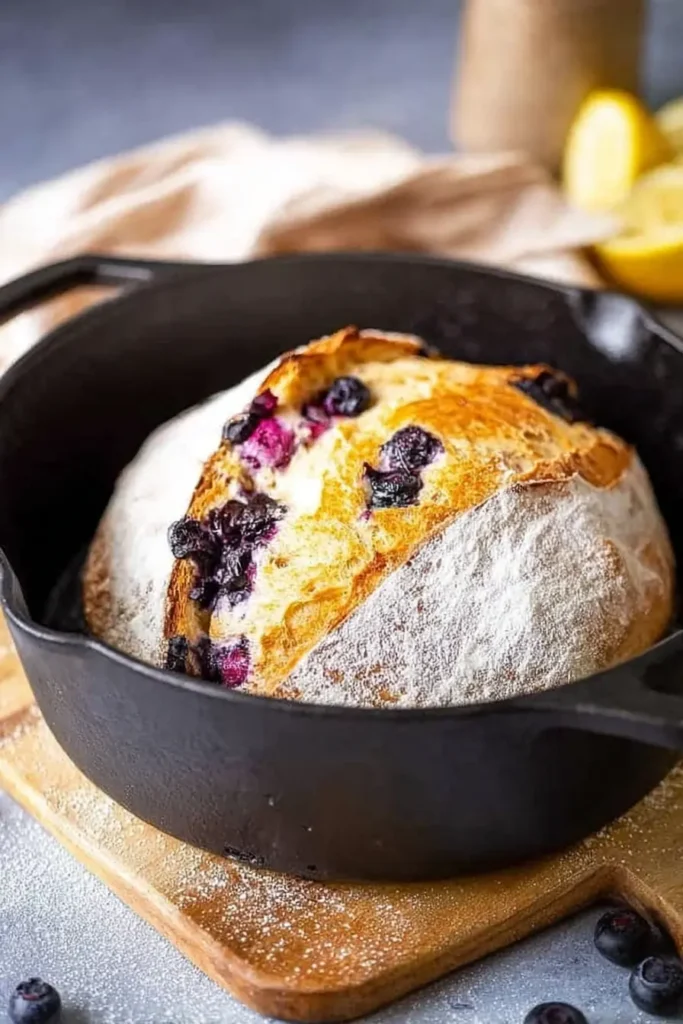
Ingredients for Lemon Blueberry Sourdough Bread
Levain/Starter & Base Dough
- 160 g active sourdough starter (100% hydration; bubbly and doubling reliably)
- 400 g strong white bread flour (≥ 12–13% protein)
- 240 g room-temperature water (hold back 10–20 g if your flour hydrates less)
- 1 tsp fine sea salt
- 1 Tbsp granulated sugar (optional but helps tenderness and browning)
Mix-Ins
- Zest of 2 lemons (finely grated; avoid white pith)
- 150 g fresh blueberries (small, firm berries ideal; see Notes if using frozen)
Dusting
- Rice flour or all-purpose flour for banneton and handling
Yield: One medium boule (about 800–850 g baked weight).
Ingredient Notes (Smart Substitutions & Tips)
- Bread flour vs. all-purpose: High-protein bread flour supports fruit and gives taller structure. If using all-purpose, reduce water by 10–15 g and be gentle during folds.
- Starter hydration: A 100% hydration starter (equal parts water and flour by weight) gives an open but controlled crumb. If your starter is thicker or thinner, adjust the dough water a touch to keep a soft, tacky feel—not soupy.
- Sugar: Optional, but a tablespoon softens the crumb and boosts browning without making the loaf “sweet.”
- Lemons: Zest only; juice weakens gluten and slows fermentation. If you want extra lemon aroma, rub zest into the sugar before mixing to release oils.
- Blueberries: Fresh, firm berries bleed less and sit neatly in the crumb. If using frozen, do not thaw; dust lightly in flour and add straight from the freezer during lamination. Expect a slightly more marbled interior.
- Whole-wheat variation: Swap up to 100 g of bread flour with white whole wheat for nuttiness; add 5–10 g more water if dough feels tight.
- Salt: Don’t skimp; it strengthens gluten and balances fruit sweetness.
Step-by-Step Instructions
Step 1 – Build or wake up your starter
Feed your starter 6–12 hours before mixing so it peaks when you’re ready. It should smell mildly sweet-tangy, look airy with many bubbles, and float in water when a small spoonful is tested.
Step 2 – Autolyse (hydrate flour)
In a large bowl, mix 400 g flour and 220–230 g water until no dry bits remain. The dough will look shaggy. Cover and rest 30–60 minutes. Autolyse hydrates flour and kickstarts gluten formation, which means less mixing later and better extensibility for lamination.
Step 3 – Mix in starter, salt, and sugar
Add 160 g active starter, 1 tsp salt, 1 Tbsp sugar. Pinch and fold until well incorporated, then perform 5–8 minutes of “stretch and fold in the bowl” or gentle slap-and-fold on the counter until the dough is smoother and cohesive. If it’s very stiff, add the last 10–20 g water gradually. You’re aiming for a soft, elastic dough that pulls from the bowl but is still tacky.
Step 4 – Bulk fermentation with strength-building folds
Transfer dough to a lightly oiled, clear-sided container. Ferment warm (ideally 75–78°F / 24–26°C) for 3–5 hours, depending on starter strength and room temp. During the first 2 hours, perform 3–4 sets of coil folds every 30–40 minutes:
- To coil fold: With wet hands, lift the dough from the center; the ends will drape down. Tuck the ends underneath so the dough folds over itself. Rotate the container and repeat. You’ll feel it tighten each round.
Step 5 – Laminate and add lemon + blueberries
When the dough has gained notable elasticity and some gas (about 60–70% through bulk), laminate:
- Lightly mist a clean counter with water. Ease the dough out and gently stretch into a large rectangle without tearing (as thin as you can without resistance).
- Evenly scatter the lemon zest and blueberries over the surface. If using frozen berries, dust them in a teaspoon of flour first.
- Fold the dough like a tri-fold letter from top to center, bottom to center, then left to center and right to center. You’ve now trapped and distributed the mix-ins.
- Return dough to the container, seam down. Rest 20–30 minutes, then do one gentle coil fold to re-tension (optional if dough still feels robust).
Step 6 – Finish bulk (watch the dough)
Let the dough rise until it looks airy, domed at the edges, and has grown about 40–60% in volume. Poke test: a damp finger pressed ½ inch should spring back slowly, leaving a soft impression. Overproofing risks tearing where berries sit, so err slightly under rather than over.
Step 7 – Pre-shape and bench rest
Turn dough onto a lightly floured counter. With a bench knife, tuck edges to form a loose round, creating light surface tension. Rest 15–20 minutes, uncovered, to relax the gluten.
Step 8 – Final shape
Dust a banneton with rice flour. Using your bench knife and floured hands, shape a tight boule:
- Flip dough (sticky side up). Fold top third down, sides to center, then roll from top to bottom to form a taut ball.
- Spin gently against the counter to tighten the “skin.” Place seam-up in the banneton.
Step 9 – Cold proof (retard)
Cover and refrigerate 12–18 hours (up to 24–36 if your fridge is cold and starter is lively). The dough will slowly rise and firm up, making scoring easier and flavor deeper.
Step 10 – Preheat and score
Place a Dutch oven with lid on the center rack and preheat to 480°F / 250°C for 45–60 minutes. Cut a piece of parchment long enough to act as a sling. Invert the cooled dough onto parchment, dust lightly with flour, and score a confident ¼–½ inch deep slash from top to bottom at a slight angle (a “grigne” score). This controls expansion and gives that signature ear.
Step 11 – Bake with steam, then color
Carefully lower the dough (on parchment) into the hot pot. Cover and bake 20 minutes at 480°F / 250°C. Reduce to 435°F / 225°C, uncover, and bake 18–25 minutes more until the crust is deeply golden and the loaf registers 205–210°F / 96–99°C internal. If the bottom darkens too fast, slide the loaf off the parchment onto the oven rack for the last 5 minutes.
Step 12 – Cool completely
Move the loaf to a rack and cool at least 1½–2 hours before slicing. The crumb finishes setting as it cools. Cutting too early compresses the structure and can smear the berry pockets.
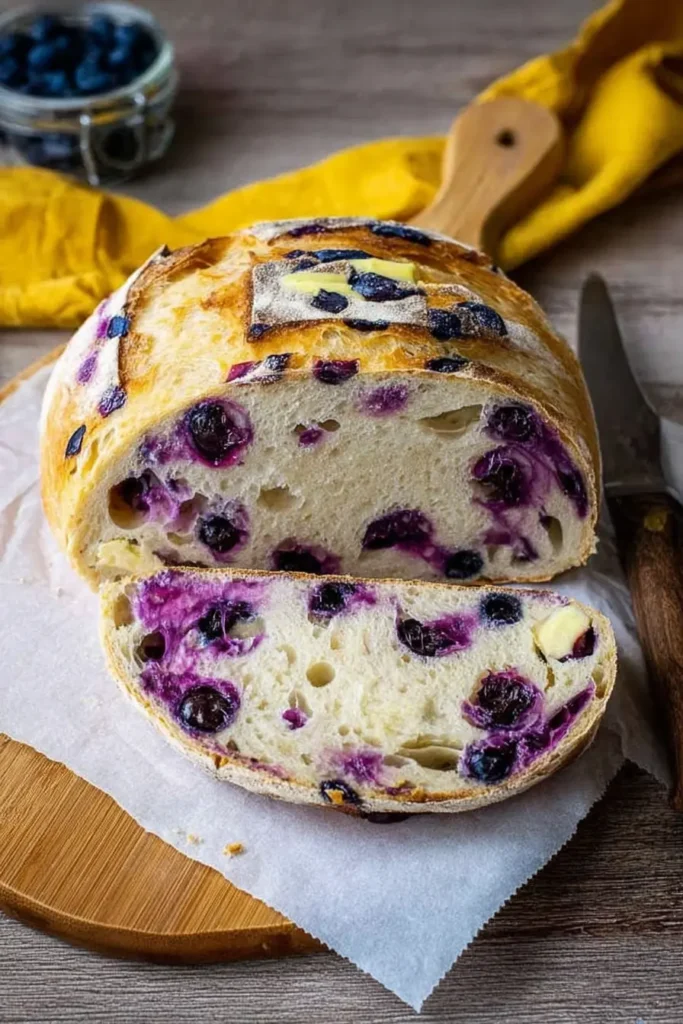
Pro Tips for Success
- Temperature is your steering wheel: Warmer kitchens shorten bulk; cooler rooms extend it. Use water that keeps dough in the 75–78°F zone after mixing.
- Gentle hands with fruit: Avoid mashing berries during lamination. Use small, firm berries and spread them evenly.
- Coil folds early, not late: Build structure in the first half of bulk; after fruit goes in, limit folds to one gentle set if needed.
- Cold proof for flavor and control: It tightens the gluten “skin,” making scoring cleaner and crumb more even around berries.
- Score with confidence: A shallow, hesitant score can cause random ruptures where fruit sits; go a clean ¼–½ inch.
- Listen for the crackle: That soft “song” after baking signals a thin, well-set crust.
- Store correctly: Cut side down on a board, covered loosely with a cotton towel the first day to keep crust crisp; then bag for softness.
Flavor Variations
- Lemon–Vanilla: Rub zest with 1–2 tsp sugar and ½ tsp vanilla bean paste before lamination for bakery-level aroma.
- Triple Berry: Swap half the blueberries with raspberries or blackberries (fresh, firm). Add gently; expect a more marbled crumb.
- Citrus Medley: Use a blend of lemon and orange zest for a rounder citrus profile.
- Almond Crunch: Sprinkle a handful of slivered almonds during lamination and dust crust with a whisper of sugar before baking for a lightly caramelized top.
- Whole-Wheat Kiss: Replace 100 g bread flour with white whole wheat for mild nuttiness; add 5–10 g water if dough tightens.
Serving Suggestions
- Morning toast: Lightly toast and spread with a creamy topping and a drizzle of honey. Add extra lemon zest for fragrance.
- Brunch board: Serve thick slices with fresh berries, yogurt, and a jar of lemon curd-style spread.
- Afternoon pick-me-up: Pair with tea or coffee; the citrus aroma shines as the slice warms.
- Dessert-leaning: Make French toast; the berries caramelize at the edges, and the lemon scent lifts every bite.
- Savory balance: Serve alongside a simple salad or grilled chicken—light, fresh flavors love this bread’s brightness.
Storage and Freezing Instructions
- Day 1–2: Store at room temperature, cut side down on a board, covered with a towel or in a bread bag. Avoid the fridge—it stales the crumb.
- Day 3–4: Slice and freeze in a zip-top bag with parchment between slices. Toast straight from frozen.
- Revive the crust: If the crust softens, place the unsliced loaf in a 350°F (175°C) oven for 8–10 minutes to re-crisp.
Nutrition Facts (Per Slice)
Approximate nutrition for 12 slices per loaf, based on bread flour, blueberries, and lemon zest; values vary by flour brand and hydration.
| Calories | Protein (g) | Carbs (g) | Fat (g) | Fiber (g) | Sodium (mg) |
|---|---|---|---|---|---|
| 155 | 5 | 31 | 1 | 1 | 160 |
Troubleshooting Guide
- Dough spreads after shaping: Likely underdeveloped gluten or too warm/fast bulk. Add one extra coil fold earlier next time; keep dough near 75–78°F and shorten bulk slightly.
- Berries burst and leak excessively: Overhandling during lamination or berries too soft. Use firmer berries; laminate gently; avoid additional folds after adding fruit.
- Weak oven spring: Underproof (too tight) or overproof (structure collapsed) dough; or oven not hot enough. Ensure a full preheat and proof until dough slowly springs back when pressed.
- Gummy interior: Sliced too soon or underbaked. Check internal temp (205–210°F) and cool at least 90 minutes before cutting.
- Dense crumb around fruit pockets: Common with large berries. Use small berries, distribute evenly, and avoid dumping a pile in one area.
- Pale crust: Bake uncovered longer, or increase uncovered phase by 3–5 minutes. A teaspoon of sugar in the dough also encourages color.
FAQ About Lemon Blueberry Sourdough Bread
Can I use frozen blueberries?
Yes. Keep them frozen, toss lightly in a teaspoon of flour, and add during lamination. Expect more color bleed but great flavor.
Can I make this without a Dutch oven?
Use a preheated steel or stone and add steam: a pan of boiling water on a lower rack for the first 15–20 minutes. The loaf won’t spring quite as high as in a sealed pot, but it will still bake beautifully.
How do I know when bulk fermentation is done?
Look for a 40–60% rise, a domed surface, visible small bubbles along the edges, and a slow, soft response to the poke test. Time is a guide; your dough is the truth.
My starter is new—will this still work?
If your starter doubles reliably within 4–6 hours of feeding and smells pleasantly tangy, you’re good. If it lags, give it a week more of consistent feedings before tackling enriched loaves with fruit.
Can I add lemon juice for more flavor?
Skip juice in the dough—it weakens gluten. Boost lemon instead by using extra zest and rubbing it into the sugar to release aromatic oils.
Can I make two smaller loaves?
Yes. Double the formula and divide after bulk. Shape each, proof cold, and bake one at a time. Reduce covered/uncovered bake by a few minutes for the smaller mass.
What flour can I substitute?
A 50/50 mix of bread flour and strong all-purpose works well. For a heartier note, add up to 100 g white whole wheat and increase water as needed.
TastyInspo Notes
- Zest smart: Zest directly over the mixing bowl or sugar so aromatic oils fall where you need them. Rubbing zest into sugar for 30 seconds intensifies lemon fragrance throughout the loaf.
- Lamination calm: Mist the counter, not the dough. A barely damp surface helps stretch the dough thin without sticking or tearing, keeping crumbs open around fruit.
- Chill for control: A long, cool retard not only deepens flavor but also firms fruit-studded dough, making scoring cleaner and maximizing bloom.
- Parchment sling: Cut parchment wider than the loaf so you can lower it safely into the Dutch oven and lift it out without deflating the dough.
- Slice strategy: Use a sharp, serrated knife with light pressure; let the knife do the work to keep berry pockets neat.
- Leftover magic: Day-old slices become superb French toast or sweet croutons for a berry-forward dessert salad.
Final Thoughts
Lemon Blueberry Sourdough Bread takes the timeless pleasure of a crackly artisan loaf and infuses it with bright lemon and juicy berries for a bake that feels both cozy and celebratory. With thoughtful steps—autolyse, gentle strength-building, lamination, and a patient cold proof—you’ll get consistent height, flavor, and texture. Once you’ve made it, you’ll know exactly when your dough looks strong enough to support fruit and how a confident score transforms the bake. Keep lemons, blueberries, and an active starter on hand, and this loaf can anchor lazy brunches, quick breakfasts, and gift baskets all year long.