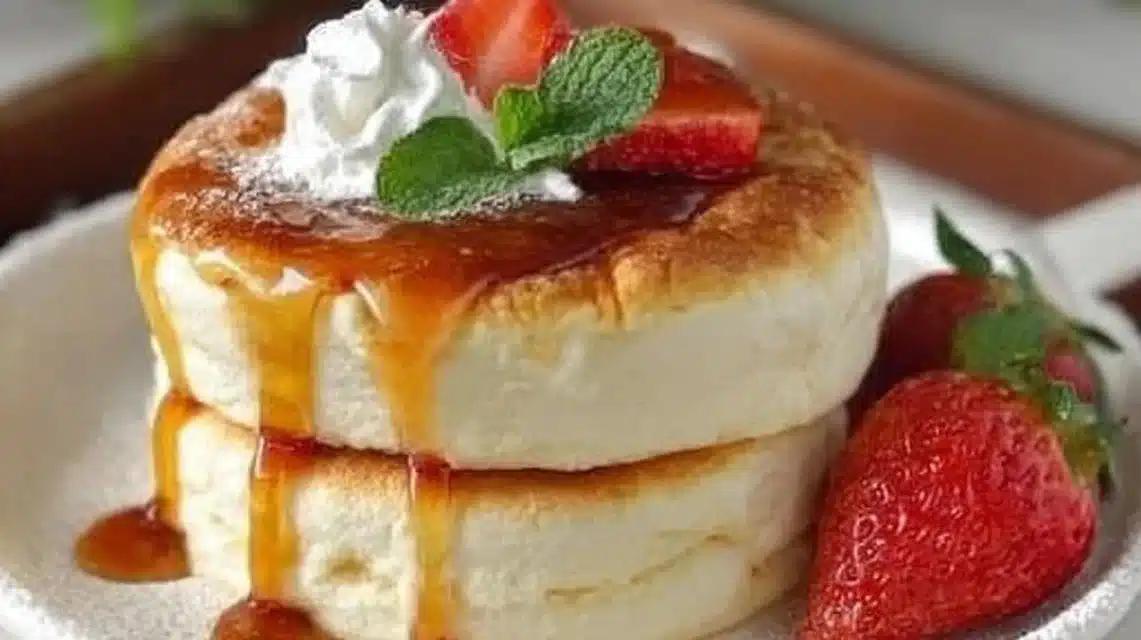
Japanese soufflé pancakes are airy, cloud-like pancakes with a tender, custardy center and a golden exterior. They taste lightly sweet with vanilla notes and melt on your tongue, offering more lift and softness than regular pancakes. This recipe is special because it uses whipped egg whites to create that soufflé rise, yet it stays simple and achievable on a stovetop for a cozy brunch. Serve them stacked with butter and maple syrup, or top with fresh berries and whipped cream for a bright contrast. If you like fruit toppings, try this best strawberry sauce to finish them.
Why You’ll Love This Japanese Soufflé Pancakes
- Ultra-light texture: whipped egg whites give a cloud-like lift that feels delicate in each bite.
- Mild, balanced flavor: vanilla and a touch of sugar highlight the egg and milk base without overpowering.
- Simple ingredients: pantry staples like flour, eggs, and milk are all you need.
- Hands-on but forgiving: folding gently matters, but small mistakes won’t ruin the result.
- Great for special breakfasts or casual brunch: impressive look with little fuss.
- Flexible serving: maple syrup, fresh fruit, or whipped cream all pair naturally.
- Stovetop friendly: you don’t need a baker or special molds — just a non-stick skillet and a lid.
- Quick to plate: each stack cooks in about 6–8 minutes per pancake, so you serve warm fast.
What Is Japanese Soufflé Pancakes?
Japanese soufflé pancakes are tall, softly whipped pancakes made by folding stiff-whipped egg whites into a yolk-based batter. They taste lightly sweet and creamy, with a delicate custard-like center and a slightly caramelized outside. What makes them special is the contrast of airy lift and tender interior—every bite feels weightless. The cooking method is stovetop steaming: low heat and a covered pan trap steam to gently cook the thick batter without burning the outside. The vibe is relaxed, comfort-forward, and a little celebratory—perfect for a weekend brunch, a cozy breakfast, or when you want an elegant-looking treat without a lot of fuss.
Ingredients for Japanese Soufflé Pancakes
For the Base
- 4 large eggs, separated
- 2 tablespoons milk
- 1 teaspoon vanilla extract
- 1 tablespoon sugar
- 1/2 cup all-purpose flour
- 1/2 teaspoon baking powder
- A pinch of salt
For Cooking
- Butter (for cooking)
To Serve
- Maple syrup (for serving)
- Fresh fruit or whipped cream (optional for serving)
Ingredient Notes (Substitutions, Healthy Swaps)
- Eggs: Use large eggs as listed. Older eggs whip more easily, so they can help when making stiff peaks.
- Milk: Any dairy milk works. For a slightly richer taste, use whole milk; for lighter calories, use 2% or a mild plant milk like oat. Keep in mind plant milk may thin the batter a touch.
- Sugar: You can use granulated sugar as written. For lower sugar, reduce to 3/4 tablespoon, but the texture of whipped whites may be slightly less stable.
- Flour & baking powder: All-purpose flour and baking powder give the classic lift. For a slightly lighter crumb, sift the flour before measuring. Do not substitute with self-rising flour unless you omit the baking powder.
- Butter for cooking: Use a neutral oil listed only if you’re avoiding dairy, but butter gives the best flavor and browning.
- Toppings: Maple syrup keeps it classic. Fresh fruit or whipped cream are optional and do not change the base technique.
Step-by-Step Instructions
Step 1 – Prepare the yolk batter
In a medium bowl, whisk the 4 egg yolks with 2 tablespoons milk and 1 teaspoon vanilla extract until smooth. Sift in 1/2 cup all-purpose flour, 1/2 teaspoon baking powder, and a pinch of salt. Mix until just combined and smooth. Avoid overmixing; a few tiny lumps are okay.
Visual cue: batter should be thick but pourable and pale in color.
Step 2 – Whip the egg whites
In a clean, dry bowl, whip the 4 egg whites until soft peaks form. While whipping, gradually add 1 tablespoon sugar and continue until stiff, glossy peaks form. The whites should hold a firm peak without collapsing.
Visual cue: when you lift the whisk, the peak should stand upright and the surface looks glossy.
Step 3 – Fold egg whites into yolk batter
Gently fold one-third of the whipped whites into the yolk batter to lighten it. Use a rubber spatula to lift from the bottom and fold over. Then fold in the remaining whites carefully until mostly uniform—do not overfold. A few streaks of white are okay.
Pro cue: folding slowly keeps air in the mixture and preserves the souffle lift.
Step 4 – Heat the pan and spoon batter
Heat a non-stick skillet over low heat and add a small pat of butter to grease. Spoon dollops of batter into the skillet, making rounds about 3–4 inches wide and mounding the batter slightly to keep height. Leave space between each pancake to allow steam to form. Cover the pan with a lid.
Visual cue: batter will spread a little but stay tall.
Step 5 – Cook and flip
Cook covered on low for 3–4 minutes until the bottoms are a deep golden color and the sides look set. Flip carefully using a wide spatula and cook covered for another 3–4 minutes until cooked through. Remove to a plate and serve immediately with maple syrup, fresh fruit, or whipped cream.
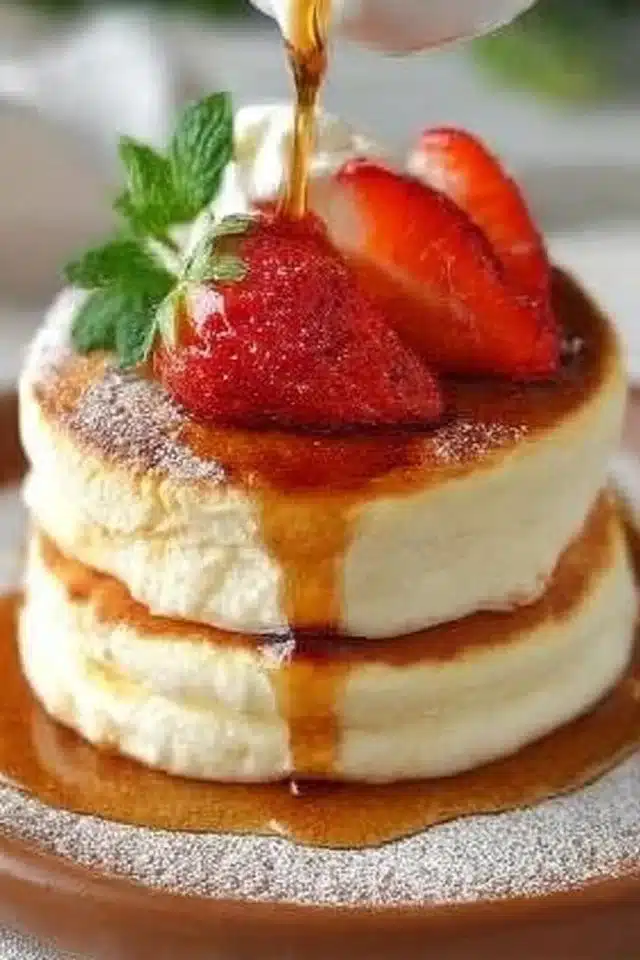
Pro cue: if centers wobble slightly when nudged but are not liquid, they are cooked through and will set as they rest briefly.
Pro Tips for Success
- Separate eggs cold, then bring whites to room temperature for better volume.
- Use a clean bowl and whisk for egg whites; any fat or water can prevent whipping.
- Whip whites to stiff peaks, but stop before they look grainy—overwhipping makes them dry.
- Low, steady heat and a lid create gentle steam. High heat will brown too quickly and leave the center raw.
- Fold with a light hand: trap as much air as possible for height. Use wide, slow strokes.
- Make pancakes uniform by measuring batter with a 1/4-cup scoop for even cooking.
- If pancakes start to brown too fast, lower the heat and add a splash of water (a few teaspoons) to the pan and re-cover to boost steam briefly.
- Serve right away; these pancakes are best warm and tender.
Flavor Variations
- Optional: Vanilla honey glaze — mix a teaspoon of honey with a little warm milk and drizzle over pancakes for a sweeter finish.
- Optional: Citrus zest — add 1 teaspoon lemon or orange zest to the yolk batter for a bright, fresh aroma.
- Optional: Matcha twist — fold 1/2 teaspoon matcha powder into the dry ingredients for a subtle green tea flavor and color.
- Optional: Chocolate marble — fold 1 tablespoon melted and cooled chocolate into a third of the batter and swirl gently before cooking.
- Optional: Cinnamon sugar — dust with a small pinch of cinnamon and sugar before serving for warm spice notes.
- Optional: Berry compote — top with lightly warmed berries; this is optional and pairs well with the pancake’s light texture.
Serving Suggestions
- Classic stack: 2–3 pancakes tall, a pat of butter, and warm maple syrup.
- Fresh and bright: top with sliced strawberries, blueberries, or mixed berries and a dollop of whipped cream.
- Decadent: serve with a scoop of vanilla ice cream and a drizzle of warm maple syrup for a dessert twist.
- Light brunch: pair with a green salad and citrus segments to cut the richness.
- Cozy breakfast: add a side of bacon or sausage if you eat meat, and a cup of strong coffee or tea.
- Party platter: make smaller pancakes and serve family-style with several toppings for a DIY bar.
Make-Ahead, Storage & Reheating
- Make-ahead: You can prepare the yolk batter and whip the egg whites just before cooking. Do not fold and store the mixed batter; it loses lift if it sits.
- Storage (fridge): Cooked pancakes will keep in an airtight container for up to 2 days. They will soften and lose some height but remain tasty.
- Reheating best practices: Reheat gently in a low oven (250°F / 120°C) for 5–8 minutes or in a non-stick skillet over low heat for 1–2 minutes per side. Avoid the microwave when possible, as it can make them rubbery.
- Texture changes: note that reheated pancakes will be less fluffy and more cake-like than fresh ones; plan to cook and serve fresh when possible.
Storage and Freezing Instructions
- Freezing: Freezing is not ideal because the whipped structure deflates and texture changes after thawing. If you must freeze, cool pancakes completely, layer with parchment paper, and freeze in an airtight container for up to 1 month.
- Thawing & reheating: Thaw in the fridge overnight and reheat in a low oven until warm. Expect some loss of height and softness.
- If freezing is not recommended: it’s better to freeze only the dry ingredients (flour, baking powder) and separate eggs or make fresh when ready for best texture.
Nutrition Facts (Per Serving)
Calories | Protein | Carbs | Fat | Fiber | Sodium
—|—:|—:|—:|—:|—:
~320 kcal | 9 g | 30 g | 18 g | 1 g | 210 mg
Estimates vary by brands and portions.
FAQ About Japanese Soufflé Pancakes
Q: Why are my pancakes flat and not tall?
A: Likely from overfolding the egg whites or not whipping the whites to stiff peaks. Be gentle folding and whip whites until they hold firm peaks.
Q: Why do my pancakes cook outside but stay raw inside?
A: Heat is too high. Lower the flame and cook covered so steam cooks the center slowly.
Q: My batter seems too thin. What went wrong?
A: You may have added too much milk or overworked the batter. The yolk batter should be thick; add a touch more flour very sparingly if needed.
Q: Can I make this without a lid or non-stick pan?
A: A lid is important to trap steam. If you don’t have a non-stick pan, use a well-seasoned heavy skillet and more butter, but be extra gentle when flipping.
Q: Can I use a sugar substitute?
A: You can, but substitutes may change how the egg whites whip. Granulated sugar stabilizes the whites best.
Q: How do I know when they are done?
A: Centers should be set but slightly jiggly. A small toothpick inserted should come out clean or with moist crumbs, not raw batter.
TastyInspo Notes
- Finish with a light dusting of powdered sugar for a restaurant look.
- Slice through the stack slowly to show the airy cross-section when serving—it’s a great visual.
- Serve on warm plates so the pancakes stay soft longer.
- Use a wide spatula and steady hands when flipping to keep the height intact.
- If you want uniform rounds, use stainless steel rings greased with butter; they are optional and work well on low heat.
Troubleshooting
Problem: Pancakes rise briefly, then fall.
Fix: Overmixing after folding knocks out air; fold gently and stop when combined.Problem: Egg whites won’t whip.
Fix: Ensure bowls and utensils are clean and dry and that there’s no yolk in the whites. Bring whites to room temperature first.Problem: Bottoms burn before centers cook.
Fix: Lower heat and cook covered longer to allow steam to set the center.Problem: Pancakes are gummy or dense.
Fix: Check measurements—too much liquid or too little flour will change crumb. Don’t overmix the base.Problem: Batter is lumpy or uneven.
Fix: Sift dry ingredients and whisk yolks until smooth before folding in whites.Problem: Pancakes stick to pan.
Fix: Use a good non-stick pan or enough butter; let pan heat on low and add fresh butter before each batch.
Final Thoughts
Japanese soufflé pancakes deliver a light, elegant breakfast with simple steps and common ingredients—whip, fold, cook low, and enjoy. They work well for special mornings and are worth the small extra effort for the cloud-like texture. For more inspiration and a different take, see a classic reference recipe at Japanese Fluffy Souffle Pancakes – The Boy Who Bakes.
Japanese Soufflé Pancakes
Ingredients
For the Base
- 4 large eggs, separated Older eggs whip more easily for better volume.
- 2 tablespoons milk Use whole or light dairy milk for different rich flavors.
- 1 teaspoon vanilla extract Enhances flavor.
- 1 tablespoon sugar Reduce to 3/4 tablespoon for lower sugar option.
- 1/2 cup all-purpose flour Sift for a lighter texture before measuring.
- 1/2 teaspoon baking powder Avoid substituting with self-rising flour.
- a pinch salt
For Cooking
- Butter (for cooking) Butter (for cooking) Provides the best flavor and browning.
To Serve
- to taste Maple syrup Classic pairing.
- as desired Fresh fruit or whipped cream Optional toppings.
Instructions
Prepare the yolk batter
- In a medium bowl, whisk the 4 egg yolks with 2 tablespoons milk and 1 teaspoon vanilla extract until smooth.
- Sift in 1/2 cup all-purpose flour, 1/2 teaspoon baking powder, and a pinch of salt. Mix until just combined and smooth. Avoid overmixing; a few tiny lumps are okay.
Whip the egg whites
- In a clean, dry bowl, whip the 4 egg whites until soft peaks form. While whipping, gradually add 1 tablespoon sugar and continue until stiff, glossy peaks form.
Fold egg whites into yolk batter
- Gently fold one-third of the whipped whites into the yolk batter to lighten it. Then fold in the remaining whites carefully until mostly uniform—do not overfold.
Heat the pan and spoon batter
- Heat a non-stick skillet over low heat and add a small pat of butter to grease. Spoon dollops of batter into the skillet, making rounds about 3–4 inches wide.
- Cover the pan with a lid.
Cook and flip
- Cook covered on low for 3–4 minutes until a deep golden color forms on the bottoms and the sides look set.
- Flip carefully and cook covered for another 3–4 minutes until cooked through. Remove to a plate and serve immediately.